Is SEO dead? No, but the traffic it sends is shrinking fast. People are searching Google more than ever. What has changed is that a growing share of those searches end without a click, because Google’s AI Overviews and tools like ChatGPT answer the question on the page. Ranking still matters. Being the source the AI quotes now matters more, because that is increasingly where the remaining clicks go.
I run an AEO and SEO practice, so I have a stake in this question. That is why I want to be precise about it: the “search is dying” story is wrong, and the “nothing has changed” story is wrong too.
Search volume is not falling
The prediction everyone remembers came from Gartner in February 2024: “By 2026, traditional search engine volume will drop 25%.” It is 2026, and that has not happened.
- SparkToro and Datos estimated that Google searches grew about 21.6% in 2024, to more than 5 trillion a year.
- In its Q2 2026 earnings, Alphabet said search usage hit an all-time high, and that AI Mode passed 1 billion monthly users. Google publishes no raw query counts, and it has every reason to frame this well, but independent clickstream data points the same way.
- A SparkToro study found that 95% of Americans still use traditional search, and heavy search use actually rose slightly, even as about 20% of Americans became heavy AI users.
There was one scare. In May 2025, Apple’s Eddy Cue testified that Google searches in Safari had fallen for the first time in 22 years. Google disputed it the same day. It was one month, on one browser.
Clicks are falling sharply
This is the part that is real. Searches are up, but each search sends less traffic to websites.
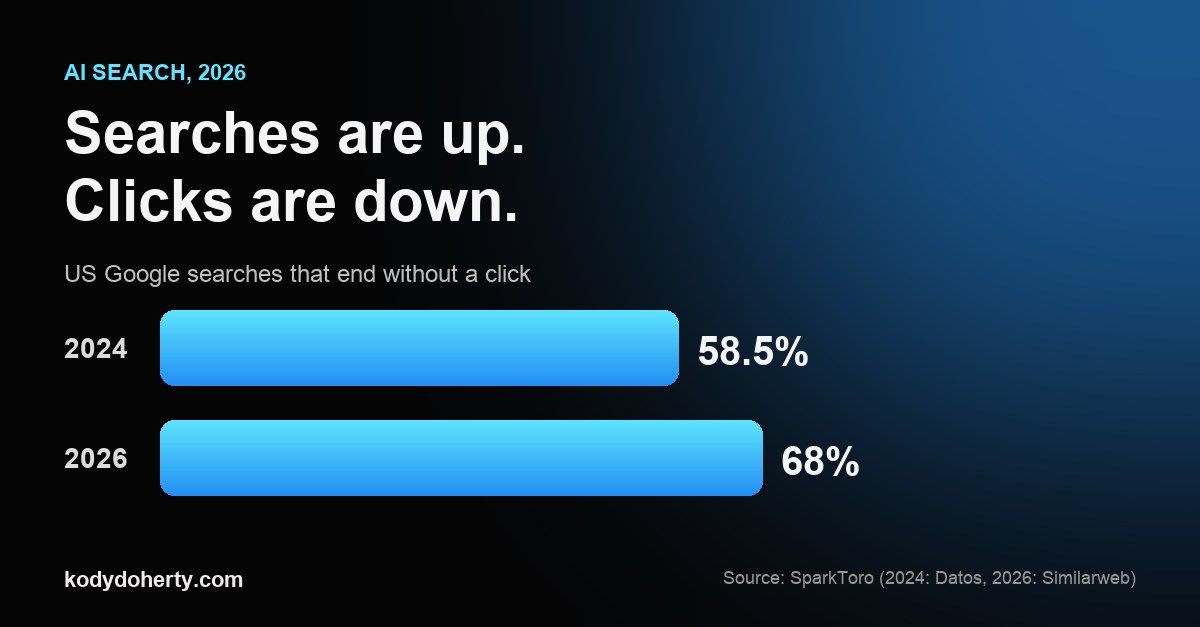
- Zero-click searches: SparkToro found 58.5% of US Google searches ended without a click in 2024. By early 2026, using different data, it was 68%. The authors warn that the data providers changed between studies, but the direction is clear.
- The top result gets fewer clicks: Ahrefs found the number-one organic result earned 34.5% fewer clicks when an AI Overview appeared (March 2025). Its 2026 update put the drop at 58%.
- Real users behave this way: Pew Research tracked 900 US adults and found they clicked a regular result on 8% of visits with an AI summary, versus 15% without one. Links inside the summary itself were clicked on just 1% of visits.
Google says total organic clicks are “relatively stable” and higher quality. It has not published the data behind that.
There is some recovery, and a clear winner
Seer Interactive has tracked this closely. In September 2025 it reported that organic click-through on queries with AI Overviews had fallen 61%. Its April 2026 update, covering 53 brands and 2.43 billion impressions, found click-through recovering from 1.3% to 2.4% between December 2025 and February 2026. Seer’s own verdict is cautious: the worst “may have passed.”
The most useful finding in that update: brands cited inside the AI Overview earned about 120% more organic clicks per impression than brands that were not cited. That is the new ranking game. The page the AI quotes gets the traffic that is left.
How big is ChatGPT, really?
Big, and still much smaller than Google for search.
- OpenAI said in February 2026 that ChatGPT had 900 million weekly users, up from 400 million a year earlier.
- In July 2025, Sam Altman said ChatGPT handled over 2.5 billion prompts a day. Most of those are not searches. They are writing, coding and conversation.
- Traffic from AI tools to websites is growing fast from a small base. Similarweb measured about 770 million AI referral visits a month worldwide, up 117% in a year. That is still well under 1% of all web traffic.
- The quality is high. Adobe reported that in March 2026, retail visitors arriving from AI tools converted 42% better than other visitors. A year earlier they converted 38% worse.
The honest summary: Google is still where most of your customers search. AI tools are where a growing, high-intent slice of them get answers, and many of them use both.
What AI engines actually cite
This is where most advice online overstates what is known. Here is what the larger studies found:
- Brand mentions matter more than backlinks. Across 75,000 brands, Ahrefs found mentions of a brand around the web correlated much more strongly with AI Overview visibility (0.664) than backlinks did (0.218).
- Fresh content gets cited more. Content cited by AI assistants was, on average, 25.7% fresher than what ranks in regular Google results.
- Each engine has favorite sources. Across 680 million citations, Profound found Wikipedia made up 47.9% of ChatGPT’s top 10 cited sources, while Reddit was 46.7% of Perplexity’s.
One thing I will not claim: I have not found a rigorous study proving that schema markup or FAQ sections by themselves cause more AI citations. I still use both, because they make a page easier for any machine to read and they cost little. But anyone selling you schema as a guaranteed AI ranking factor is ahead of the evidence.
What to do about it
- Keep doing SEO. Google volume is at a record high, and AI Overviews draw heavily on pages that already rank. Weak SEO usually means weak AEO too.
- Answer the question in the first paragraph. AI engines lift direct answers. A page that makes readers scroll past an introduction before answering is harder to quote.
- Get mentioned off your own site. Reviews, local news, industry directories, podcasts, Reddit threads and partner pages build the brand signal that correlates most with AI visibility.
- Update your important pages. Freshness correlates with citation. A dated “last updated” line on a page that actually changed is worth having.
- Measure citations, not only rankings. Track whether ChatGPT, Perplexity and Google’s AI Overviews mention you for the questions your customers ask. Traffic alone will understate how often you are seen.
- Judge AI traffic by conversions, not volume. It is small, but it converts well.
Frequently asked questions
Is SEO dead in 2026? No. Google search volume is at a record high by Google’s account, and independent data shows growth. What is falling is the number of clicks each search sends: about 68% of US Google searches ended without a click in early 2026, up from 58.5% in 2024.
What is AEO? Answer engine optimization means making your content easy for AI tools like ChatGPT, Perplexity and Google’s AI Overviews to find, trust and quote. It builds on SEO rather than replacing it.
Do AI Overviews reduce website traffic? Yes, for most sites. Studies from Ahrefs, Seer Interactive and Pew found fewer clicks when an AI summary appears. Seer also found that brands cited inside the AI Overview earn about 120% more clicks per impression than brands that are not.
Is traffic from ChatGPT worth anything? It is small, well under 1% of web traffic, but growing more than 100% a year. In retail it now converts better than other traffic, according to Adobe.
Does schema markup help you get cited by AI? It makes your content easier for machines to read, and it is cheap to add. But there is no rigorous evidence yet that schema alone causes more AI citations. Brand mentions and fresh, direct answers have stronger evidence behind them.
If you want to know how often AI tools mention your business today, and what it would take to change that, that is what my SEO and answer engine optimization work covers.