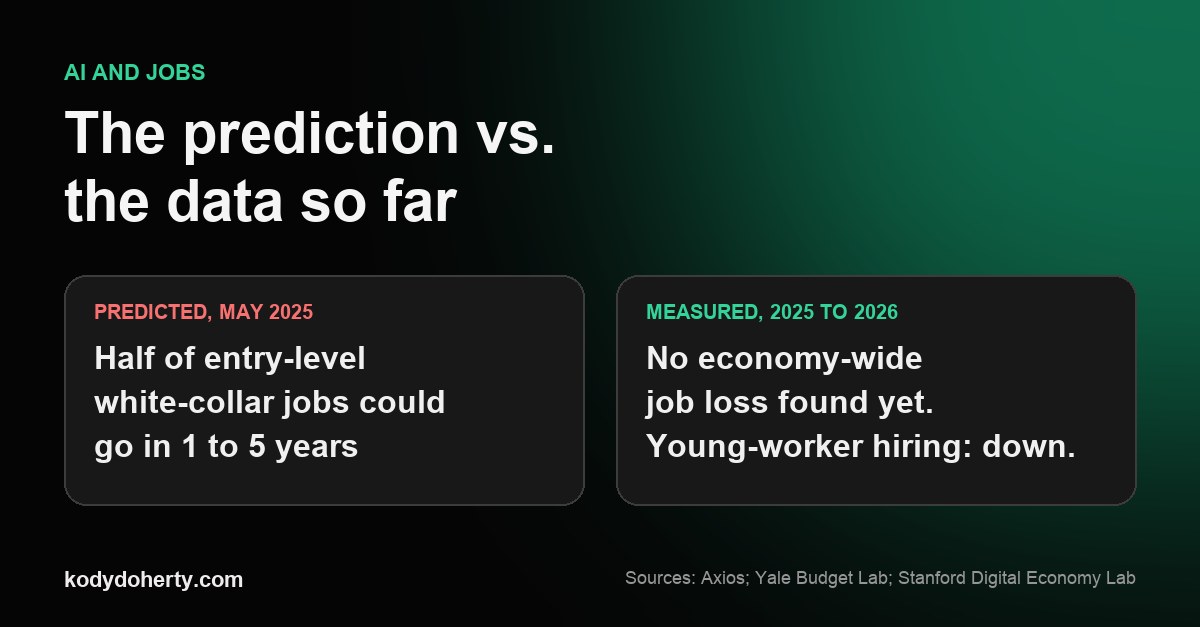
Is AI about to wipe out white-collar work? Not on the evidence so far. Nearly four years after ChatGPT launched, economy-wide studies still find no measurable AI-driven job loss, and controlled studies show real but uneven productivity gains. There is one genuine warning sign, and it is narrower than the headlines: fewer entry-level hires in the jobs AI can do on its own. For most businesses, the near-term story is a smaller team doing more, not a team replaced.
I build AI agents and automation for a living, so I have every commercial reason to tell you AI changes everything. It does change a lot. But the loudest predictions are coming from people who sell the technology, and the data has not been kind to them.
The predictions
The most-quoted warning came from Anthropic CEO Dario Amodei in May 2025. As Axios reported it, AI “could wipe out half of all entry-level white-collar jobs” and push unemployment to 10 to 20% within one to five years.
Others followed. Amazon CEO Andy Jassy wrote in a June 2025 memo that AI would “reduce our total corporate workforce” over the next few years, though he gave no number. Salesforce CEO Marc Benioff said he had cut support staff from 9,000 to 5,000 because “I need less heads.” In July 2025, OpenAI CEO Sam Altman predicted customer support jobs would be “totally, totally gone.”
Not everyone agreed. Nvidia CEO Jensen Huang said he disagrees with “almost everything” Amodei says on the subject.
Notice who is talking. A company selling AI benefits when buyers believe AI is powerful enough to replace people. That does not make the predictions wrong, but it is a reason to check them.
What happened next
The sharpest correction came from one of the people making the predictions. In May 2026, Altman told TIME: “I don’t think we’re going to have the kind of jobs apocalypse that some of the companies in our space advocate or talk about.” He added that he expected more impact on entry-level white-collar jobs “by now than has actually happened.”
Two of the best-known “replace the humans” stories were partly walked back:
- Klarna said in February 2024 that its AI assistant was doing the work of 700 full-time agents. By May 2025 its CEO was telling Bloomberg that focusing on cost had led to “lower quality,” and Klarna started hiring human agents again. AI still handles most of its chats. What changed is that customers can reach a person.
- Duolingo announced an “AI-first” policy in April 2025, then clarified after the backlash that it would keep hiring at the same pace and did not plan to replace employees with AI. Contractors were still cut.
What the employment data shows
Three independent studies, three different methods, one answer so far:
- Yale Budget Lab found in October 2025 that “the broader labor market has not experienced a discernible disruption since ChatGPT’s release.” A May 2026 follow-up still found no clear effects.
- A Danish study of 25,000 workers in 11 AI-exposed occupations found no significant effect on earnings or hours. The confidence intervals rule out effects bigger than 1%. That data runs through 2024, before today’s agent tools.
- Stanford’s Digital Economy Lab, using ADP payroll data through June 2026, found “no evidence of widespread, economy-wide job displacement” (August 2026 update).
The one signal that is real
The same Stanford paper found something that should not be waved away. Workers aged 22 to 25 in the most AI-exposed jobs are now employed at levels 19% below where they would be had they kept pace with less-exposed peers. That gap was 13% when the researchers first reported it in August 2025, and it has widened since. Experienced workers in the same jobs show no comparable gap.
The mechanism matters. The decline comes mostly from companies not hiring young workers, not from firing existing staff. It is concentrated in jobs where AI substitutes for the work. In jobs where AI assists the worker, employment is flat or rising.
The authors call the finding descriptive, not causal, and the effect shrinks when you control for education. But it is the clearest displacement signal in the data, and it points at a real problem: if AI does the junior work, where do the next senior people come from?
What the productivity studies show
The controlled studies are more interesting than the headlines, because they disagree in a useful way.
- Customer support: a study of 5,179 agents published in the Quarterly Journal of Economics found AI assistance raised productivity 14% on average and 34% for novice and low-skilled workers, with minimal gain for experienced agents. Customer sentiment improved too.
- Consultants: in the Harvard and BCG “jagged frontier” study of 758 consultants, AI users completed 12.2% more tasks, 25.1% faster, at over 40% higher quality, on tasks AI was good at. On a task just outside AI’s ability, they were 19 percentage points less likely to get the right answer than people working without it.
- Experienced developers: a 2025 METR trial found experienced open-source developers took 19% longer with AI tools on codebases they knew well. The more striking part: they expected a 24% speedup and afterwards believed they had been 20% faster. METR is redesigning the study and says later results are less clear, but the gap between perception and reality is the lesson worth keeping.
Put together: AI lifts the floor more than the ceiling. It helps newer people and well-defined tasks the most. It can quietly make experts worse on hard problems, and people are bad at telling which situation they are in.
Layoffs “because of AI”
AI is now a common stated reason for layoffs. Challenger, Gray & Christmas counted 116,175 announced cuts citing AI through August 2026, about 22% of all announced cuts and the leading reason this year (August 2026 report). In all of 2025, AI was cited in 54,836 of 1,206,374 announced cuts, about 4.5% (2025 year-end report).
Two caveats before reading that as proof. These are announcements, and the reason is whatever the company says it is. Challenger itself has flagged “the ambiguous nature of what constitutes AI-attributed cuts.” And total announced cuts through August were down 41% from the same period in 2025. AI is a growing share of a shrinking number, and “AI” is a more flattering reason to give investors than “we over-hired.”
What this means if you run a small business
Only about 1 in 5 US businesses uses AI at all, according to the Census Bureau, and use at firms under 20 employees has not changed significantly. Small businesses are not being hollowed out by AI. Most have not started.
That is the opportunity. The evidence points to a practical way to use AI that holds up:
- Automate the work, not the role. Look for the repetitive, well-defined tasks inside a job, such as intake, data entry, first drafts and follow-ups. Those are inside the “frontier” where the studies show real gains.
- Give the gains to your newer people first. The biggest measured improvements went to novices. AI can shorten the time it takes a new hire to become useful.
- Keep a human on judgment calls. The consultants who got worse results were using AI on a task it could not do, without knowing it. Decide in advance where a person has to check the output.
- Measure, do not trust the feeling. The developers in the METR study felt faster and were slower. Time the task before and after.
- Keep hiring juniors. If AI does all the entry-level work, you will have no one ready to become senior in five years. The companies that skip this will pay for it later.
The realistic outcome for most teams is that the same people get more done and spend less time on work nobody wanted to do.
Frequently asked questions
Is AI causing mass layoffs? Not so far. Economy-wide studies from Yale, Stanford and Denmark find no measurable AI-driven job loss nearly four years after ChatGPT. AI is increasingly cited in layoff announcements, but those reasons are self-reported, and total announced cuts in 2026 are down from 2025.
Which jobs are most affected by AI? Entry-level roles in jobs where AI can do the work on its own. Stanford found employment for workers aged 22 to 25 in the most AI-exposed jobs is 19% below trend, mostly because companies hired fewer of them. Where AI assists workers instead of replacing the task, employment is flat or rising.
Does AI actually make teams more productive? Often, but unevenly. A study of 5,179 support agents found a 14% average gain and 34% for novices. Consultants did better on tasks AI handles well and worse on a task it could not. Experienced developers in one trial were 19% slower while believing they were faster.
Should a small business use AI to replace staff? Rarely. The evidence favors automating specific repetitive tasks and keeping people on judgment, customer relationships and anything that needs checking. Klarna’s experience shows that replacing people to cut costs can cost you quality and customers.
How do I start using AI in my business safely? Pick one repetitive, well-defined task, measure how long it takes today, automate it with a person reviewing the output, and measure again. Expand only where the numbers improve.
If you want help finding the tasks in your business that are worth automating, and the ones that are not, that is what my AI and automation work is for.